


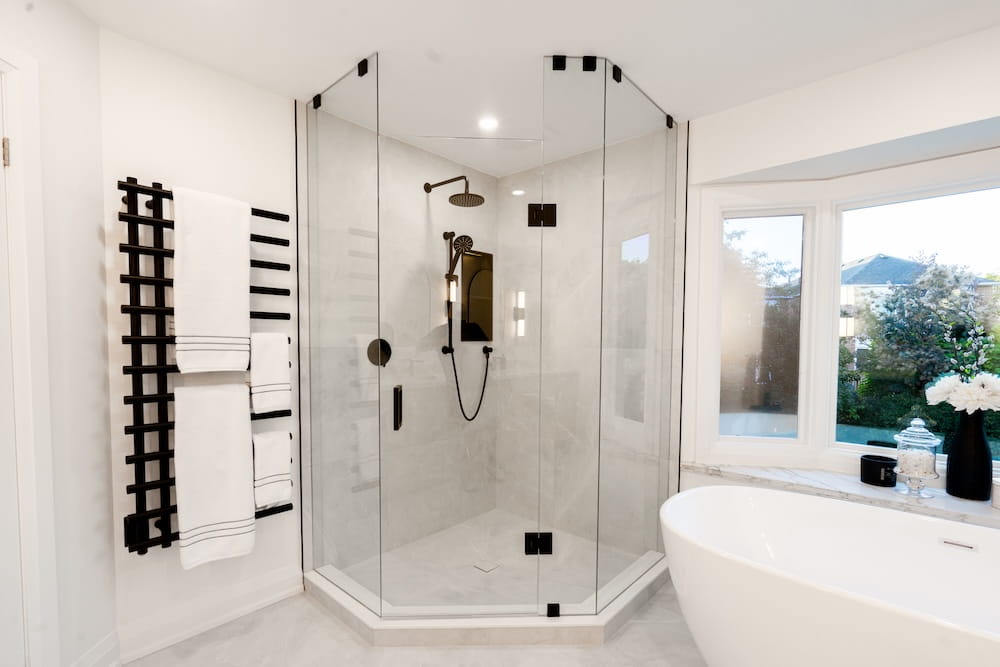
Key takeaways
- Published 2026 guides put a tub-to-shower conversion at about $6,000 to $15,000, and a full accessible bathroom renovation typically costs $20,000 or more.
- The Home Accessibility Tax Credit covers up to $20,000 of eligible expenses a year for people 65 and older or eligible for the Disability Tax Credit, worth up to $2,800 for 2026.
- From the 2026 tax year, an expense claimed under the Medical Expense Tax Credit no longer counts toward the Home Accessibility Tax Credit, although both could be claimed for 2025.
- The March of Dimes Home and Vehicle Modification Program pays up to $15,000 for zero-threshold roll-in showers with waterproof panels, but not tile, glass doors or step-in showers.
- Ontario’s Seniors’ Home Safety Tax Credit has ended, and most GTA municipal repair programs are closed, although Hamilton and Halton still offer help.
Short answer: converting a tub to a walk-in shower in the GTA typically costs around $6,000 to $15,000, and a full accessible bathroom renovation with a curbless shower, grab bars and wider doorway typically costs $20,000 or more, depending on the room. Three federal tax credits can help: the Home Accessibility Tax Credit (worth up to $2,800 for 2026), the Medical Expense Tax Credit and, if you are creating a separate suite, the Multigenerational Home Renovation Tax Credit. In Ontario, the main grant is the March of Dimes Home and Vehicle Modification Program, which pays up to $15,000 for eligible low-income homeowners. Most GTA municipal home-repair grants have closed.
The rules changed for 2026: you can no longer claim the same expense under both the Home Accessibility and Medical Expense credits, even though many government pages still say you can. This guide covers costs, every program that actually exists in October 2026, which ones have ended, and the design details that make a bathroom genuinely accessible. Program rules were checked against the Canada Revenue Agency, federal law, the Government of Ontario and each program’s own documents.
What a walk-in shower or accessible bathroom costs
| Project | Published range | Source |
|---|---|---|
| Tub-to-shower conversion with an acrylic base and walls | $6,000 to $12,000 | HomeStars national guide, 2026 |
| New shower installation in Toronto | $8,000 to $15,000 | HomeStars Toronto guide, 2026 |
| Full accessible bathroom renovation | $20,000 to $30,000 | Accessibility contractor quoted in the Globe and Mail, 2022 |
| Full bathroom renovation, our pricing | From $15,999; most small full bathrooms $16,000 to $25,000 | Remodel My Home |
These are market ranges, not quotes. There is no reliable Canadian published price for a curbless shower specifically, because the cost depends so much on the floor. What drives it:
- Curbless or low curb. A true zero-threshold shower needs the floor recessed or built up so water drains away from the room. In a house with wood joists, that can mean structural work and an engineer; on a basement slab it means cutting concrete.
- Tile or panels. A tiled, fully waterproofed shower costs more than an acrylic or solid-surface panel system, and the March of Dimes program only funds panels (below).
- Moving the drain. Relocating plumbing adds cost and usually a permit.
- Doorway and layout. Widening a doorway or reworking the room for a turning circle costs more than a like-for-like swap.
- Blocking. Adding solid backing for grab bars is inexpensive while walls are open and awkward once they are closed.
Our GTA bathroom renovation cost guide breaks down where bathroom money goes in more detail.
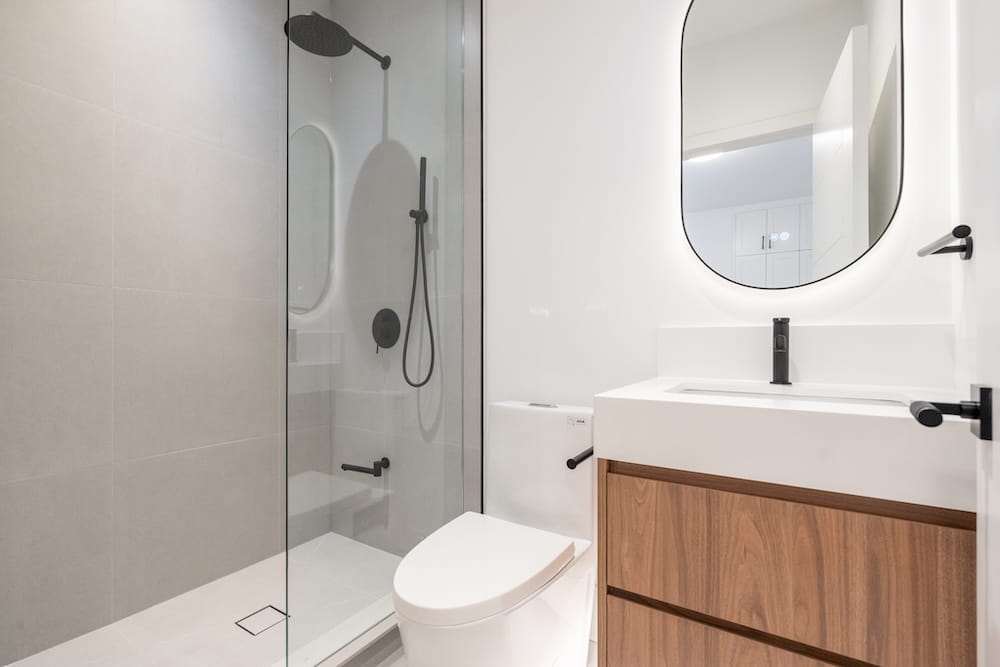
The Home Accessibility Tax Credit
The federal Home Accessibility Tax Credit (line 31285 of your return) is the main tax break for accessibility renovations.
- Who qualifies: a person 65 or older at the end of the year, or eligible for the Disability Tax Credit. A spouse, certain relatives or a person who claims the disability amount for them can also make the claim. The home must be in Canada, owned by one of these people and ordinarily lived in by the qualifying person.
- How much: up to $20,000 of eligible expenses a year per home, at the lowest federal tax rate: 15% through 2024, 14.5% for 2025 and 14% from 2026. That makes it worth up to $2,900 on a 2025 return and up to $2,800 on a 2026 return. It is non-refundable, so it reduces tax owing.
- What counts: renovations that are part of the home and either improve access, mobility or function, or reduce the risk of harm. The federal budget that created the credit gave walk-in bathtubs, wheel-in showers, grab bars and wheelchair ramps as examples. Materials, fixtures, permits, plans and trade labour count.
- What does not: routine repairs and maintenance, appliances, items that can be used apart from the renovation, financing costs, work done mainly to add value, rental or business areas, and your own labour if you do it yourself.
The Medical Expense Tax Credit
Renovation costs can also qualify as medical expenses when they let a person with a severe and prolonged mobility impairment get into, move around or function in their home. The costs must be reasonable, would not normally add value to the home, and would not normally be incurred by someone without the impairment. The CRA’s examples include ramps, widening halls and doorways, and lowering kitchen or bathroom cabinets. Ask your contractor for an itemized invoice that separates the accessibility work. Bathroom aids for getting in or out of a tub or shower or on or off a toilet need a prescription.
Medical expenses only count above a threshold: for 2025, the lesser of $2,834 or 3% of net income.
The 2026 change: one expense, one credit
Until the 2025 tax year, the same accessibility renovation cost could be claimed under both the Home Accessibility Tax Credit and the Medical Expense Tax Credit. Federal legislation that received royal assent on March 26, 2026 ended that for the 2026 tax year onward: an expense claimed as a medical expense no longer counts toward the Home Accessibility Tax Credit. Some CRA pages and guides still describe the double claim, which is only correct for 2025 returns. Which credit is better for a given expense depends on your income and province, so this is a question for your accountant.
If you are building a separate suite
The Multigenerational Home Renovation Tax Credit only applies when you create a new self-contained unit, with its own entrance, kitchen, bathroom and sleeping area, so that a senior or an adult eligible for the Disability Tax Credit can live with a relative. An accessible bathroom built as part of that suite can qualify; a bathroom renovation in the main house cannot. It is refundable and is calculated on up to $50,000 of costs: 14.5% for 2025 (up to $7,250) and 14% from 2026 (up to $7,000). Costs claimed under this credit cannot also be claimed under the medical expense or home accessibility credits. Our guide to legal basement apartments in Ontario covers what a separate unit requires.
Ontario programs: what exists and what has ended
| Program | Status in 2026 | Key details |
|---|---|---|
| March of Dimes Home and Vehicle Modification Program | Active (Ontario-funded) | Up to $15,000 lifetime for home modifications, for Ontario residents with a permanent mobility disability and household income under $60,000 (with a contribution above $35,000). Details below. |
| Ontario Seniors Care at Home Tax Credit | Active | For people 70 and older: a refundable credit of 25% of claimable medical expenses, up to $1,500, reduced above $35,000 of family net income and gone above $65,000. Qualifying renovation expenses count as medical expenses. |
| Ontario Seniors’ Home Safety Tax Credit | Ended | Applied only to the 2021 and 2022 tax years. |
| Assistive Devices Program | Does not cover this | Excludes grab bars, bath and shower aids and home renovations. |
| Ontario Renovates (run by municipalities) | Mostly closed in the GTA | See the municipal list below. |
The March of Dimes program in detail
The Home and Vehicle Modification Program is the most useful grant for an accessible bathroom, but it is specific about what it pays for. It funds a “wet room” style bathroom: a zero-threshold roll-in shower finished with waterproof panels, grab bars, a handheld shower on a slide bar, an accessible sink and toilet, and door widening. It does not fund walk-in or step-in showers, walk-in tubs, tile and grout, glass shower doors or cosmetic work. You must own the home, an occupational therapist assesses your needs, two competitive itemized quotes are required, and March of Dimes pays the contractor directly. Work done before approval is not reimbursed, so apply before you book anything, and check the program’s current intake with March of Dimes Canada.
Municipal programs in the GTA
- Toronto: the Toronto Renovates homeowner program has closed.
- Peel Region (Mississauga, Brampton, Caledon): Peel Renovates is no longer offered.
- York Region: no current homeowner repair program.
- Durham Region: no current homeowner repair program found.
- Halton Region: the Halton Accessibility Repair Program funds items such as walk-in showers, grab bars, stair lifts and ramps on a first-come, first-served basis with a small annual budget. Call 311 to ask.
- Hamilton: Ontario Renovates is open, offering forgivable loans of up to $25,000 for eligible lower-income homeowners and persons with disabilities.
Veterans
Veterans Affairs Canada’s Veterans Independence Program can fund home adaptations such as grab bars, slip-resistant flooring, wider doorways and converting a room into a bathroom, up to $7,883.78 for 2026. Approval is needed before the work starts.
Design details that make a bathroom accessible
The Ontario Building Code does not require barrier-free design inside houses, so an accessible bathroom is a design choice. The CSA B652 standard for accessible dwellings, which is voluntary and covers renovations to existing homes, is the best reference. Its key recommendations, paraphrased:
| Element | CSA B652 guidance |
|---|---|
| Turning space | A 1,500 mm circle in a renovated bathroom |
| Shower size | At least 900 by 1,500 mm inside, with 900 mm of clear space in front |
| Threshold | No more than 13 mm, bevelled if over 6 mm; zero threshold preferred |
| Floor slope | 1 to 2% toward the drain |
| Grab bars and blocking | Bars 30 to 40 mm in diameter; solid backing in all walls between 400 and 1,600 mm high, and tub and shower walls to the ceiling |
| Toilet | Seat 430 to 485 mm high; centreline 460 to 480 mm from the side wall |
| Door | 860 mm clear width |
| Water and controls | Water limited to 49°C; handheld shower hose at least 1,800 mm long; controls within reach |
Even if nobody in the house needs these features today, two are worth doing in any bathroom renovation: solid blocking for future grab bars, and a shower entry that is as close to level as the floor allows.
Do you need a permit?
In Toronto, replacing plumbing fixtures in the same location does not need a permit, but installing or modifying plumbing does, as do structural changes. A tub-to-shower swap with the drain in place usually needs no permit; moving the drain, adding fixtures, or recessing the floor joists for a curbless shower usually does. Toronto charges $23.20 per plumbing fixture in 2026.
Planning an accessible bathroom
- Get the assessment first if you plan to apply for the March of Dimes grant or claim medical expenses, and apply for any grant before booking the work.
- Decide between tile and panels with the funding rules in mind.
- Ask for an itemized quote that separates accessibility work from cosmetic work, for your tax claims.
- Keep every invoice and receipt in the name of the person claiming.
- Talk to your accountant about which credit to use for each expense from 2026 onward.
Thinking about a walk-in shower or accessible bathroom?
We build walk-in and curbless showers and full accessible bathrooms across Toronto and the GTA, with grab bar blocking, comfort-height fixtures and wider doorways, and we provide itemized quotes you can use for tax claims and grant applications. Our full-service bathroom renovations start at $15,999. Book a free consultation, or see our bathroom renovation services in Burlington, Brampton, Markham and across the GTA.
Walk-in shower and accessible bathroom FAQs
How much does it cost to convert a tub to a walk-in shower?
Published 2026 guides put an acrylic tub-to-shower conversion at about $6,000 to $12,000 and a new shower installation in Toronto at $8,000 to $15,000. A curbless, fully tiled shower costs more, especially if the floor has to be recessed.
Is there a government grant for a walk-in shower in Ontario?
The March of Dimes Home and Vehicle Modification Program funds zero-threshold roll-in showers with waterproof panels for eligible homeowners with a permanent mobility disability and household income under $60,000. It does not fund step-in showers, tile or glass doors. Hamilton offers forgivable loans through Ontario Renovates; most other GTA municipal programs have closed.
How much is the Home Accessibility Tax Credit worth?
It applies to up to $20,000 of eligible expenses a year at the lowest federal tax rate, so it is worth up to $2,900 for 2025 and up to $2,800 for 2026.
Can I claim the same renovation under the Home Accessibility and Medical Expense credits?
For the 2025 tax year, yes. From the 2026 tax year onward, no: an expense claimed as a medical expense no longer counts toward the Home Accessibility Tax Credit.
Does the Ontario Seniors’ Home Safety Tax Credit still exist?
No. It only applied to the 2021 and 2022 tax years. Ontarians 70 and older may instead benefit from the Ontario Seniors Care at Home Tax Credit on qualifying medical expenses.
Do I need a permit for a walk-in shower in Toronto?
Not if fixtures are replaced in the same location. Moving the drain, adding plumbing or altering the floor structure for a curbless shower generally needs a permit.
Does the Building Code require an accessible bathroom in a house?
No. The Ontario Building Code does not require barrier-free design inside houses. The voluntary CSA B652 standard is the best guide for designing one.